
Mandy borrowed the Knighton Wild bat detector and wrote this account of their bat walk:
We (Pete and Mandy) have been doing the Bat Conservation Trust’s online course – Introduction to Bats (which we’d thoroughly recommend if you’re as fascinated as we are by these furry fliers.) One of the sessions focused on echo location and how to use different kinds of bat detectors. Noting that Knighton Wild included a heterodyne bat detector in the arsenal of wildlife monitoring equipment recently acquired, we asked if we could borrow it to check for bat action on Knighton Green.
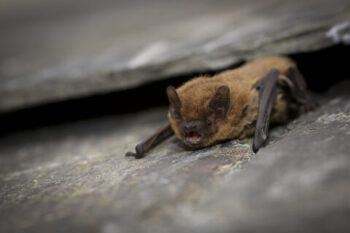
So, on the last Saturday in August, while everyone around us seemed to be having house parties, we set off to the Green, as the sun was disappearing. To be honest, we weren’t expecting to hear anything, as we perched on the bench and turned the detector to 46 (the best frequency for Common Pipistrelles, the most likely bats to be around in that habitat and at that time of evening).
Image left: Common Pipistrelle bat copyright Tom Marshall
We didn’t have to wait long before picking up something that sounded very much like the ‘wet slapping’ sounds (or ‘syncopated jazz beat’ as Pete described it) that we were listening for. They seemed to be coming from the wooded area by Balmoral Close. We walked around that area but, not hearing anything else, we headed into the church yard. After being nearly blinded by the floodlights (lovely for illuminating the church, but not very bat-friendly!), we walked to the side of the church nearest the brook. Here we heard what sounded like loads of Common Pips (but was actually probably just one or two). We listened, for ages before heading home, feeling like we’d had our own little party!

As well as the bats, we also heard what we’re pretty sure was a tawny owl, in the trees on the Green, and spotted a fox strutting up the path. On a subsequent visit, we picked up a Common Pip just as we approached the bridge over the Washbrook. This time, not only did we hear it, but saw it, silhouetted in the fading light, swooping over the brook, seeking and feeding on the insect life. (The detector makes a kind of farting noise when the bat closes in on its prey which, I confess, our inner 12-year-olds delighted in!) Common Pips can munch through around 3000 insects a night. So, all the work being done to restore the ecosystem around the brook can only help to increase the food supply and improve the habitat for these fascinating creatures.
Recent Comments