
If you hate midges, please read to the end of this – and then let us know what you think.
In 1979 Leicester City Council carried out a flood relief scheme along the Wash Brook (Saffron Brook) in Knighton. This involved constructing the flood reservoirs in Knighton Park and putting the Brook into a straight, square concrete channel. The channel was engineered to move as much water downstream as quickly as possible. In retrospect this turned out to be a bad idea, for at least two reasons. First, as the climate has changed, our weather now increasingly consists of drought or heavy rain, and if you live downstream having all that floodwater dumped on you in a short space of time is a bad idea. Whether you live in Aylestone or Bangladesh, slowing down the flow of water in rivers to prevent floods rather than speeding them up is now the way to go. By carefully removing some of the concrete, the Saving the Saffron Brook project is aimed at the best of both worlds – slowing down the flow in the brook during heavy rain without flooding houses in Knighton. The second reason the concrete channel was a bad idea is that the straight, square profile was designed to wash away mud and silt which would naturally collect in the channel by speeding the flow. That may not seem to be a problem, but read on.
Regular readers will know that we are using the Trent Biotic Index to measure the water quality in Saffron Brook. Depending on the invertebrates found this gives a score from 0 to 10, where zero is basically liquid sewage and 10 is a mountain stream tumbling down a Scottish hillside. The concrete channel is devoid of plant life, apart from algae, which really likes the sewage overflow from the Oadby treatment plant. But in a few places, at the side of the channel, obstructions such as fallen branches and stones allow a little bit of silt to collect. But silt is good. No, really – read on.

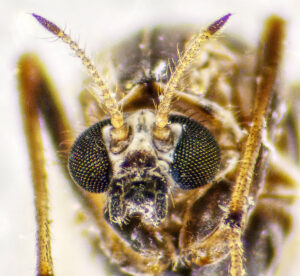
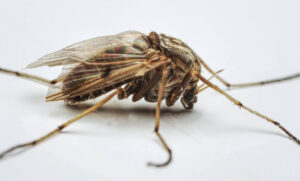
Right down on the first rung of the biotic index are red Chironomid larvae, common name “Non-biting Midges”. These are known to anglers and fishkeepers as “bloodworms” (they’re insects, not worms – they have legs!). The good news is that they’re not mosquitos, they don’t bite you and they don’t spread any diseases. The adults, if they feed at all, eat nectar and pollen from flowers. The aquatic larvae feed on tiny organic particles in sediment. That includes sewage sludge. Yes, they’re not that fussy – they’re the cleaners you might commonly find in holes in tree trunks and garden ponds rather than in a nice clean brook. In fact, the only place they can cling on in our Brook is in the sediment which collects in a few places. That’s why they only score 1 on the biotic index. So far, not a very persuasive case in favour of Chironomids, but please read on, because it gets interesting.
Chironomids are at the base of the food chain. The larvae clean up the Wash Brook by eating the sewage and decaying vegetation, and then they get eaten by pretty much everything else. Life is tough if you’re a Chironomid – you spend most of your life in the mud eating sewage and then you get eaten. “Bloodworms” are a major year-round source of food for fish. In the Wash Brook, that means Three-spined Sticklebacks, but further downstream towards the Soar, other fish species too. And Sticklebacks mean Kingfishers, which we see occasionally in Knighton, and the Little Egret which is now a Knighton resident. But if there were more Sticklebacks, there would undoubtedly be more frequent visits from Kingfishers, and more Egrets, and to get more Sticklebacks, we need more bloodworms. And to get more bloodworms, we need more silt and less concrete. But read on, it gets better.
When, after its silty aquatic life the poor Chironomid finally emerges as an adult Non-biting Midge, before it can finally take a sip of nectar or mate, the vast majority get eaten by – well, lots of things. The Grey Wagtails we occasionally see along the Brook love to eat midges – so more midges, more Wagtails. And Swifts and similar birds such as Swallows and Martins also depend mostly on tiny insects such as midges – the bloom of these insects each summer is the reason they bother flying all the way back to Leicester from South Africa (they don’t come for the scenery or a Leicester City home match). Swift numbers are declining rapidly, and in our lifetimes they could be gone. There are lots of reasons for this and we can put up as many nest boxes as we like, but if there’s not enough food for them, there will be fewer Swifts in future.
And then there are the bats. Our commonest bat, the Common Pipistrelle, feeds almost exclusively on tiny insects such as midges and can eat up to 3,000 each night. The Soprano Pipistrelle is more closely associated with water than the Common Pipistrelle and so consumes even more aquatic insects. Daubenton’s Bat only feeds over water and as a larger animal than a Pipistrelle, needs more food. All that flying is hard work – try flapping your arms for a couple of hours and see how you feel. More midges, more bats. And so it goes on. Dragonflies and Damselflies eat lots of midges too.
The harmless, humble Chironomid living in the silt at the edge of the Brook is essential to all the more charismatic animals that we may want to see. If you want more bats, Damselflies, Dragonflies, Egrets, fish, Kingfishers, Swallows, Swifts, Martins and lots more, we need more midges and they need a place to live. They won’t fill your house with flies, they stick around the water where the hot midge action is going on. Here’s the bottom line: concrete equals flooding downstream and less wildlife. Silt is good.
Alan Cann
Absolutely brilliant description of what is happening in our Brook Alan – every time you post something I learn a little more – thank you.