
Alan Cann takes a (much) closer look at what lurks below the waves of Saffron Brook
Regular readers will know that Knighton Wild has been sampling invertebrate life in Saffron Brook to measure the water quality. Freshwater invertebrates are inconspicuous, first because they are underwater, but also because they are small and need a much closer look to reveal themselves.
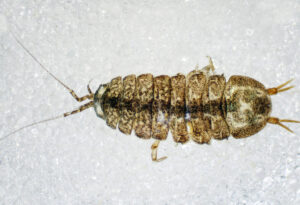
The Two-spotted Water Hog-louse, Asellus aquaticus, is a very common inhabitant of freshwater. Up to 2 centimetres long, they are closely related to Woodlice. Commonly found in ponds, they feed on decaying vegetable matter and help to keep the water clean. In the Brook they keep out of the current under stones and among plants.

One of the most numerous bugs in the Brook is the Freshwater Shrimp, Gammarus pulex. Up to 2 centimetres long, they also eat decaying vegetation and are not true shrimps, although they are related to your prawn cocktail. Males grab and hold females before deciding which one is likely to produce lots of eggs. The male then carries his chosen female for several weeks until she sheds her skin and the male can mate with her. He then lets her go and she carries the developing young in a brooding pouch. After about a month, the young shrimps swim out of the brood pouch, and a few weeks later can breed themselves. As females can produce up to 50 young each month, the population soon grows.
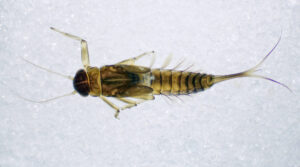
Our next inhabitant is typical of many insects in that it spends much of its lifetime as an inconspicuous aquatic larva whose main aim is to eat while avoiding being eaten, and a short flying phase which is about sex and dispersion – the insect version of the Club 18-30 holiday. Mayflies are noted for their short aerial lives and their scientific name, Ephemeroptera, acknowledges this. Wildlife documentaries always show Mayflies hatching from chalk streams and being eaten by Brown Trout, but the species which lives in the brook, the Large Dark Olive Mayfly, Baetis rhodani, is pollution-tolerant, and is the only species we have found so far.

Drawings in books always show Caddisfly larve living in cases made out of fragments of vegetation or stones. However, not all Caddisfly larvae build cases, and one of the Caseless Caddisflies, Hydropsyche siltalia, lives in Saffron Brook. Unlike the beasts described above, these insects are only present in small numbers. They are omnivorous, feeding on algae, detritus and tiny invertebrates swept by the current into the sticky capture nets they spin.
So what does all this tell us? A single sweep of a net in the Brook shows large numbers of a relatively small number of species. In part this represents what is called a trophic pyramid – the higher up the food chain an organism is, the fewer the numbers tend to be. However, in a pristine environment we would find a wider range of invertebrates than those which can tolerate the conditions in the Brook. Nevertheless, each of these mini-beasts has a story to tell us about our environment.
Alan Cann
Recent Comments